
Between 1982 and 1984, celebrated British photographer Chris Killip chronicled life in the small fishing village of Skinningrove. 40 years later, this powerful, humanist body of work is finally seeing the light of day.
Admittedly, several photographs from Skinningrove previously appeared in In Flagrante and Killip had also presented the work in slideshow format, as seen in a moving and insightful lecture filmed by Michael Almereyda. But he kept a tight lid on the entire series for decades, which adds an aura of mystery to it.
Working with a black and white palette, Killip documented English working class life throughout his career in ways that managed to be both painterly and realistic at the same time. The photos in this book are no exception. In one image, two ruggedly handsome young men on a small boat, one in overalls, the other’s trousers tucked into his fishing boots, look attentively at something off in the distance. Behind them, the sea merges with the horizon line to the point where it’s difficult to tell where the one ends and the other begins – the space behind them feels vast and infinite. While it’s the strength of their expressions and the intimacy of the moment that command your attention, what makes the picture even more extraordinary are the compositional details. Specifically, two small stick figures moving towards the edge of a large seawall in the distance. It’s a world that seems timeless and mystical.
The book opens with a few brief paragraphs, written by Killip in 2020, about the village and the project. He chronicles his experience gaining access to this insular world in broad strokes. It’s the kind of place where everybody knows everybody else, and where people tend to be, as Killip phrases it in his preface, “hostile to strangers, especially one with a camera.” Over time, with effort, he managed to earn their trust and gain entrance into the community.
The resulting medium-format photos are not overly idyllic (as Killip is quick to points out). Skinningrove is a place that embodies a certain type of toughness—the work, the weather, the mentality, and the grittiness and resilience of working-class men. The subjects of Killip’s photos are predominately male—and probably for good reason. In this type of community, it’s difficult to photograph married women without inviting unwanted gossip. The perpetually overcast weather becomes a character as well, the flat grey light a consistent presence. The influence of Paul Strand and Walker Evans can be sensed in these works, as well as Cartier-Bresson—always Cartier-Bresson. Perhaps, too, August Sander can be found in the sensitive social anthropology of Killip’s portraits of villagers, which appear throughout.
The sequencing, overseen by Killip before his passing, is extremely well done. The first few images set the stage perfectly: A picture postcard overview of the town from a bluff introduces the town. The next image introduces people into the landscape. In the subsequent photo, the landscape is now populated with small fishing boats. Those small fishing boats are more than just recurring motifs – they are essential to Skinningrove and the collective identity of the people who dwell there. This is a portrait of a community connected to the sea. The first few images strongly evoke the pastoral tradition, then the curtain is pulled back a little and you begin to see a very lived-in world. Killip’s formal compositions provide a sense of order to these spaces.
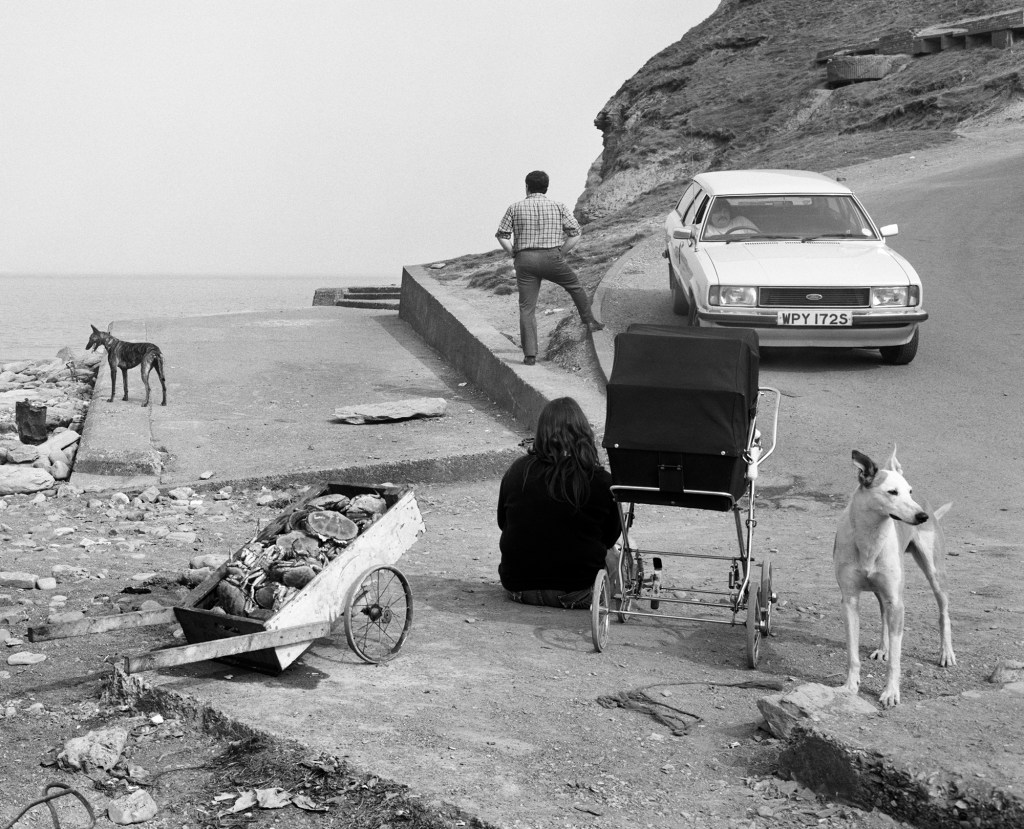
Killip approaches every situation with tenderness and sensitivity. Here are children’s games, casual conversations, the intense concentration of people hard at work. Here too are the lingering scars of barroom brawls and expressions that convey personal struggles, along with a kind of restlessness of spirit.
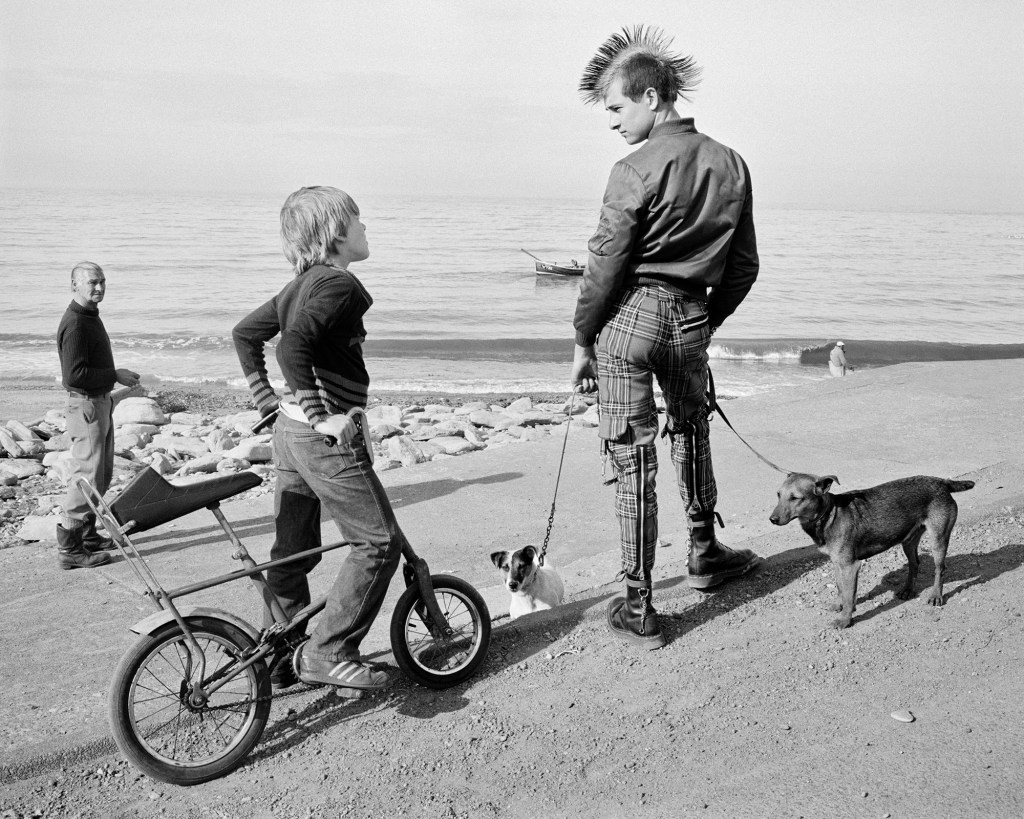
So much of Skinningrove feels timeless. Yet Killip also makes a point to show the influence of pop culture, in the form of punk music and fashion, on the young men of the town. In one photo, a young man nicknamed Whippet, sporting a carefully styled mohawk and tartan trousers, takes a break from walking his dogs to talk with a friend on a bicycle. His father looks on from the far left and farther away, a small fishing boat makes its way out to sea. All the essential components for a compelling short story present themselves in a perfectly captured moment.
Set aside for several decades, the book originated as a self-published zine that Killip distributed anonymously to the people of Skinningrove. It has now found a permanent home at UK publishing house Stanley/Barker.
Celebrating and preserving a way of life in England that has all but disappeared, Skinningrove functions as both a tribute to the people of the village and a kind of elegy as well. It is a remembrance of a disappearing way of life—and also, more literally, four young men in the photos who drowned at sea. Killip’s short dedication to their memory appears at the end of the book and further elucidates his respect and admiration for the people dedicated to this way of life. This is an essential work for those interested in the art of documenting subcultures and communities.
Skinningrove by Chris Killip. Stanley/Barker, 2024. 104 pages. Hardcover.
 The Parallax Review