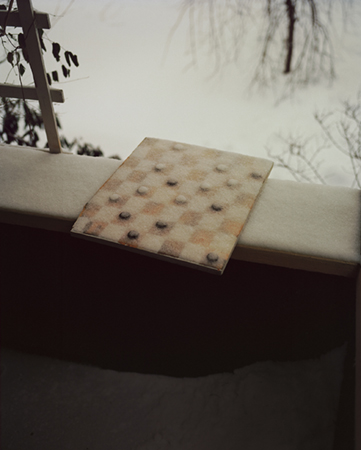
In Gregory Halpern’s latest book, King, Queen, Knave, the viewer’s initial perspective is that of an outsider who has found themself on the edge of an unknown town—a place pockmarked with the kind of snow that seems to have been there indefinitely and shows little sign of thawing anytime soon. Slowly, the sequence zooms in closer until the viewer is face to face with the people—and, occasionally, animals—who inhabit this enigmatic, contradictory landscape. Projecting both strength and vulnerability, they reveal the wounds they carry with them. The landscape bears its scars as well.
This body of work, comprised of 62 photos, was produced over two decades in the Magnum photographer’s home turf of upstate New York. While there is a subtle emphasis on social and economic issues, other elements figure more prominently. Rather than assemble a straightforward reportage, Halpern instead seeks out something not quite tangible. Ultimately, King, Queen, Knave is a highly poetic expression and a deeply personal experience of a place.
So many of Halpern’s pictures resist description that it is difficult to attempt to describe them. They seem to exist in a space beyond language. Perhaps Halpern’s greatest gift is his ability to focus on intangibles—to capture the gestalt of a place or a moment. Flip through the pages and you come across a broken gate, a house on a suburban street, a man walking through a snowy park bundled up from the cold. Easy enough to describe – yet all of these images are rendered in extraordinary ways. There is a haunting sense of dislocation embedded in their fibers. They are sublime, surreal, enigmatic, and profound in their execution.
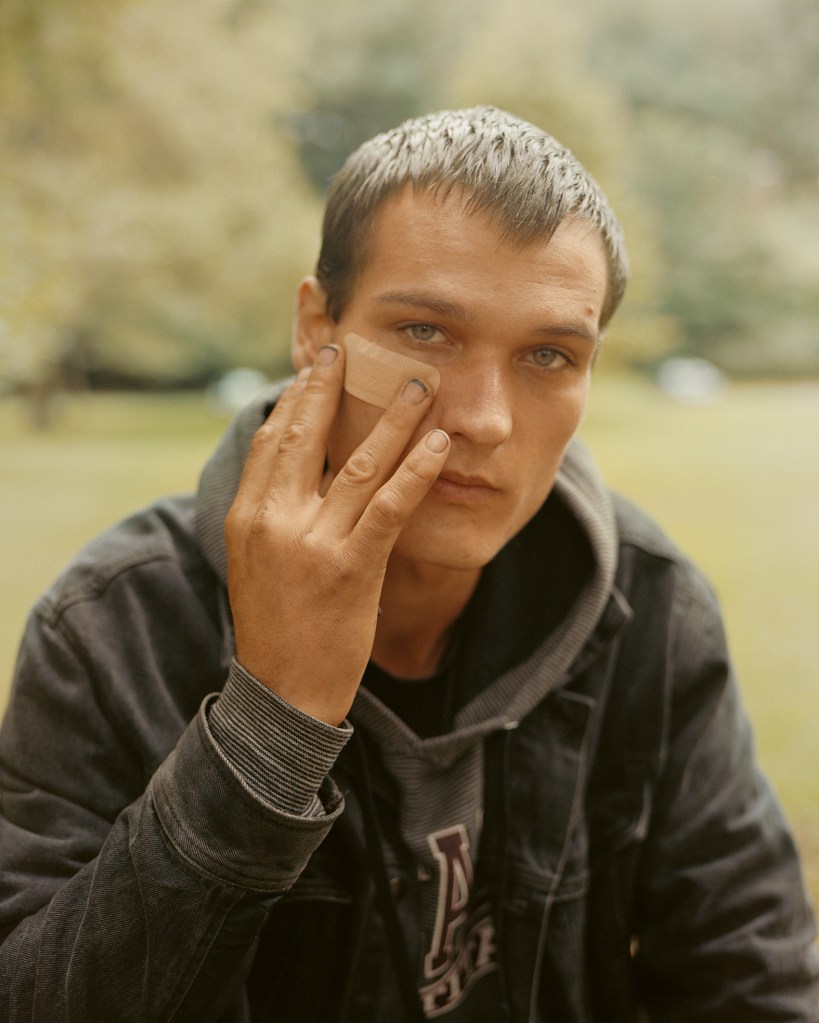
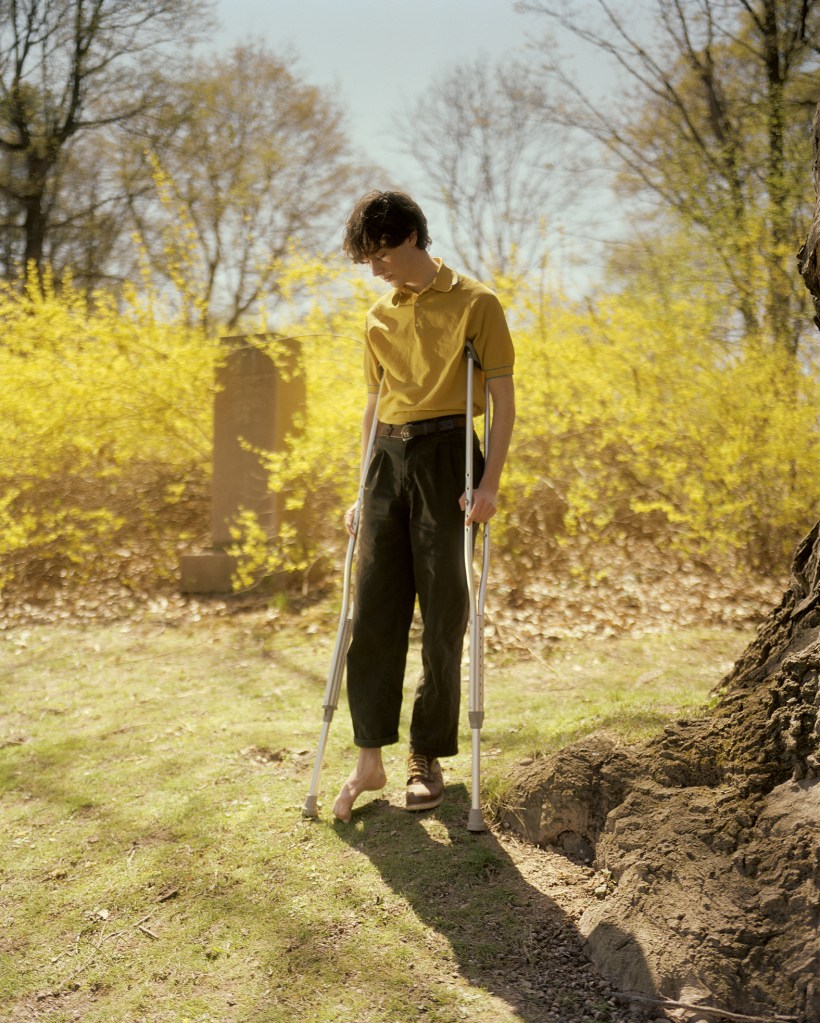
Halpern’s portraits, which are interspersed throughout, may be more “describable,” in a traditional sense (due to the fact that they are portraits), but they are rendered no less powerfully and mysteriously. Take, for instance, the image of a young man touching a large Band-Aid just below his right eye. That simple, quiet gesture reverberates emotionally without defining what that emotion is for the viewer. (Is he self-conscious about his injury or perhaps experiencing a phantom pain? There is any number of interpretations.) A carefully constructed photo of a boy on crutches, standing in a cemetery, one bare foot touching the ground in a way makes it appear deformed it as he gazes downwards contemplatively, carries similar emotional weight. There is a secondary visual impact as well—after a moment, one can’t help but marvel at how his bright yellow shirt matches the bright yellow of the foliage behind him.
Totem animals—both wild and domesticated—appear at intervals throughout the work. A white deer appears in the very first photo, ready to guide you into this world. The image of a white deer appears again, several more times, leading the viewer from inhabited and industrial spaces into a less-tamed natural space. (Whether the viewer is getting closer to a destination or further lost in a maze is difficult to say.) An owl perches on his handler’s glove, birds exist in and out of captivity, and large wolflike guard dogs skulk on the private-property side of a large metal gate. Humankind’s relationship to the natural world, a recurring theme in Halpern’s work, is prominent here.
True to Halpern’s style, every photo is a vertical. This effectively increases the sense of intimacy in his portraits. In his urban landscapes, the vertical alignment contains the environment in a limited scope, providing a counterpoint to the expansiveness of more traditional horizontal landscape photographs—both urban and natural. Verticals can also be a little disorienting, compared to “landscape mode”—a useful effect when constructing a labyrinth. Halpern’s preference for shallow depths of field adds to the dreamlike nature of the pictures.
Resolutely old-school, Halpern prefers color film to pixels, embracing the beauty and the idiosyncrasies of the analog process. As with his best-known work, ZZYZX, there is an otherworldliness to this collection of images. That transcendental quality is enhanced by the mechanical and chemical processes at work. In terms of straight photography, I generally believe that the choice of film or digital generally doesn’t really have much impact on the final image, beyond slowing down the process. Yet here, somehow, it seems as if the alchemy of the process has somehow seeped into the images themselves.
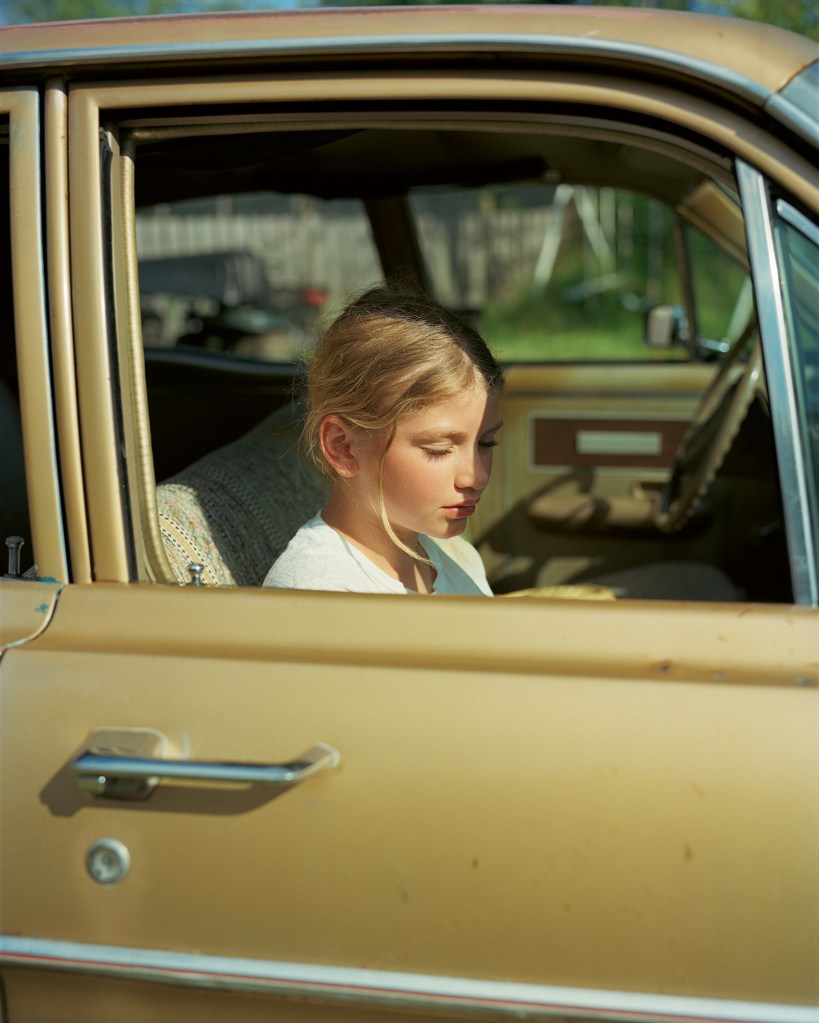
Ultimately, the snow melts and the seasons change – but what does the arrival of Spring signify? As ever, meaning is elusive. Once you reach the end of the book, there is nothing to do except to turn back to the beginning, to start the journey anew, to delve back into the mysteries, and to explore the labyrinth once more.
King, Queen, Knave by Gregory Halpern. MACK, 2024. 112 pages. Hardcover.

