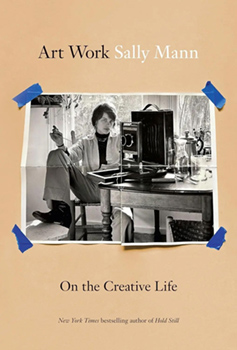
“This is a book about how to get shit done,” Sally Mann writes in the opening paragraph of Art Work. In the follow-up to her highly lauded first memoir Hold Still, Mann reflects back on her life and career, from the early work that would evolve into her best-known series “Family Pictures” to several rarely-seen projects. Along the way, she shares a wealth of insight and lessons she learned from experience, always with an arm around the shoulder. The book functions as a kind of spiritual primer, if you will, inspiring the reader to follow their vocation no matter how bumpy the road ahead seems.
It will be especially of interest to those following a more nontraditional path. Mann started out far from the epicenters of the art and photography worlds, living on a farm in the Shenandoah Valley while raising three young children. All the more because of it, she deeply understands what drives artists and the litany of issues that can befall them at any point in their careers. In an up close and personal way, she writes about the inevitable feelings of insecurity, the need for tenacity, the age-old debate of passion vs talent (nature vs nurture, if you will), the role of dumb luck in launching a career, the inescapable rejection that comes with presenting one’s work, and the general storm and stress of it all. Closer to the bone, she also recounts the psychic toll taken by various censorship battles as well as other difficult life events.
As it turns out, Mann is an incredibly insightful and eloquent writer—not just for a photographer but in comparison to other authors as well. Her writing style contains highly poetic turns of phrase, well-chosen quotes and literary references (Faulkner, Dickinson, Tolstoy, Wendell Berry), and a touch of Southern oratory as well. She’s witty, highly intellectual, and so adept at storytelling that at several points, a nonfiction reflection about the artist’s path transforms into an edge-of-your-seat page turner. A short anecdote about a rental situation on her property climaxes with a panicked Mann fording a Shenandoah Valley river on horseback in frigid weather to prevent a potential life-and-death confrontation while simultaneously receiving a prestigious award in absentia. There’s also a trip abroad that goes awry in darkly comic fashion.
Mann’s prose is often confessional and vulnerable, which makes it all the more relatable. When she writes, “Why do I insist on believing that every other working artist has it easier thank me—that they are out there effortlessly producing good, new work while I am stuffing my cabinets with rejects?” we recognize our own despairing cries to the universe, and there is comfort in this form of solidarity, knowing that even one of the greats feels that way too.
Throughout the book, Mann inspires the reader to practice their craft and to follow their own muse. An artistic practice, she writes, is “maintained with both passion and deliberately practiced skill in more or less equal measure.” She invites the reader to not just embrace all of the struggles that comes with the process but to accelerate into them. Her recipe for artistic fulfillment comes down to this: “obsession, serendipity, luck, persistence, and epiphany in undisclosed quantities.” And she leaves us with these four simple sentences: “Above all, make your work. Take your time. Make sure it’s good. Then make more of it.”
Art Work: On the Creative Life by Sally Mann (Abrams Press, 2025)
 The Parallax Review